stamper

Solora Technologies

Solora Technologies

Solora Technologies

Read time:

6 min

Client:

Solora Technologies

Industry:

Renewable Energy

Start:

November 13, 2025

Start:

November 13, 2025

End:

September 26, 2025

End:

September 26, 2025

Duration:

4 Weeks

Duration:

4 Weeks

Solora Technologies is an environmental innovation company focused on helping communities, industries, and partners transition to more sustainable practices. The goal of the website redesign was to clearly communicate their capabilities and create intuitive pathways for municipalities, investors, and waste management professionals to engage with their services.

Solora Technologies is an environmental innovation company focused on helping communities, industries, and partners transition to more sustainable practices. The goal of the website redesign was to clearly communicate their capabilities and create intuitive pathways for municipalities, investors, and waste management professionals to engage with their services.

  1. Understanding the Challenge

The Challenge

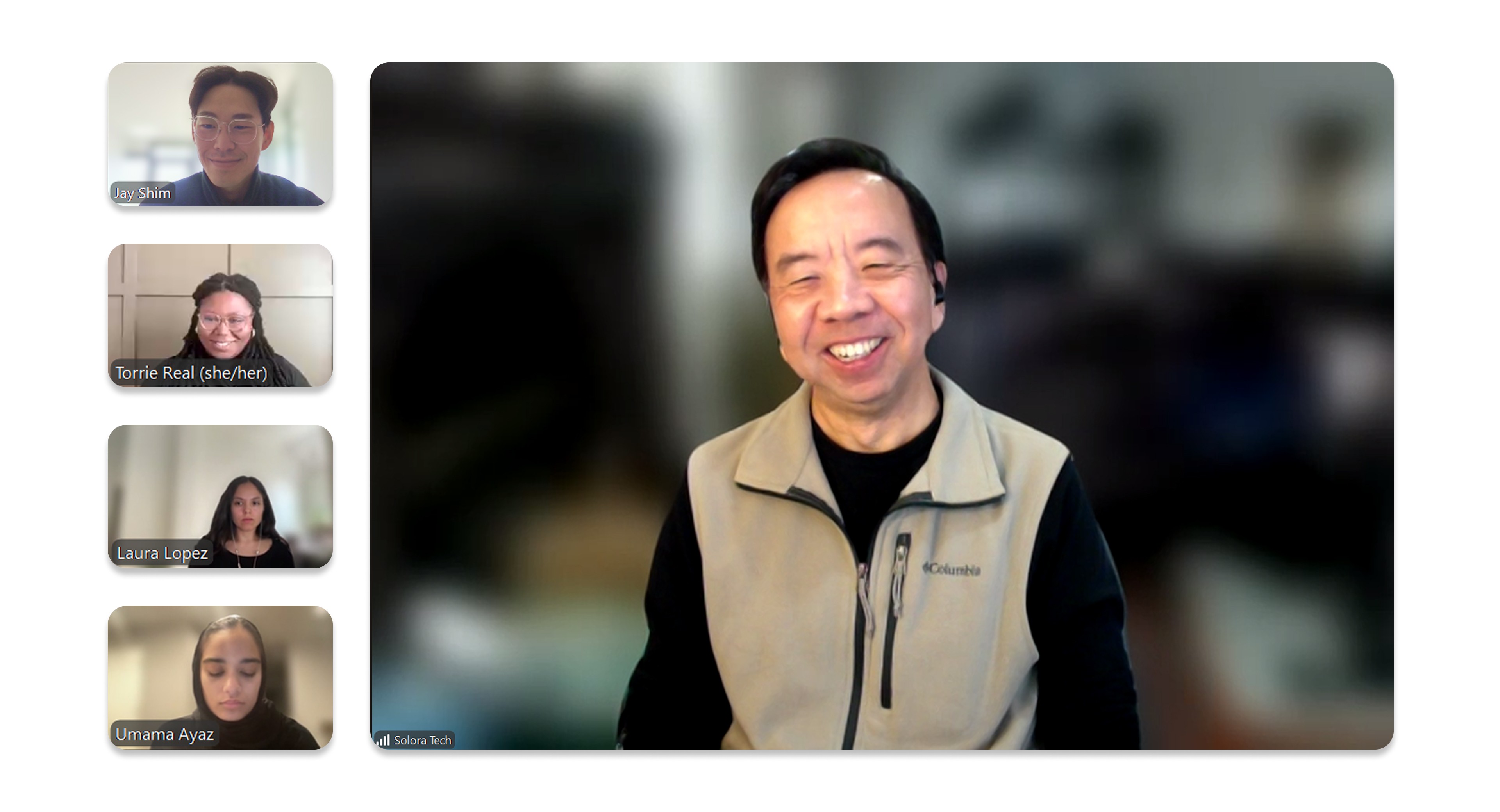
We began with stakeholder interviews to align on goals and understand Solora's diverse capabilities across five core areas: waste-to-resource solutions, clean energy, environmental analytics, technology integration, and regulatory support.

Key Questions Asked:

  • How did the company get started and evolve?

  • Can you walk us through the steps a prospect goes through before becoming a client?

  • What differentiates your company within the environmental technology space?

  • If you could choose three words to describe your brand personality, what would they be?
The Problem

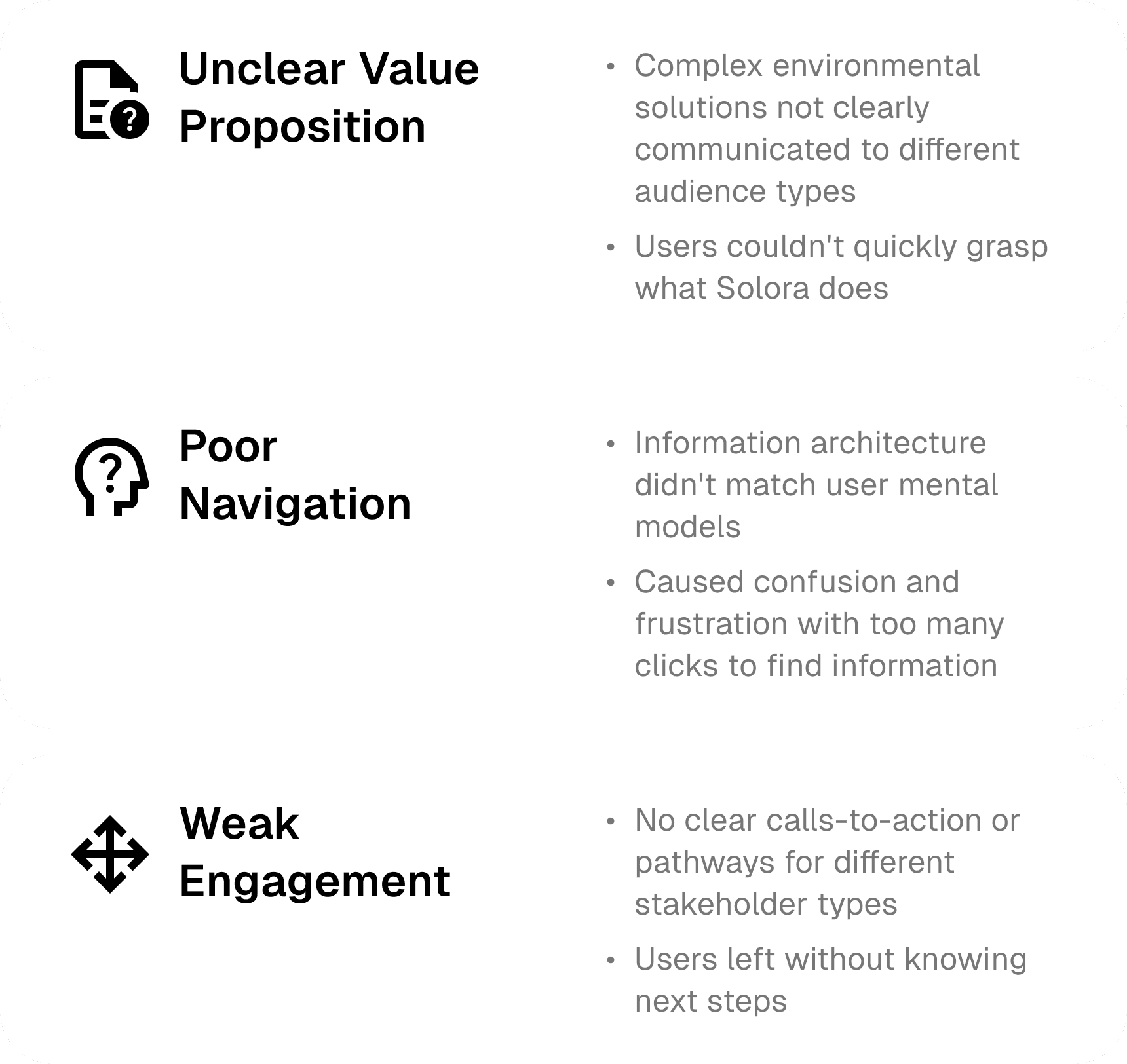
The existing site struggled with three core issues that prevented users from understanding offerings and taking action:

Unclear Value Proposition

  • Complex environmental solutions not clearly communicated to different audience types

  • Users couldn't quickly grasp what Solora does

Poor Navigation

  • Information architecture didn't match user mental models

  • Caused confusion and frustration with too many clicks to find information

Weak Engagement

  • No clear calls-to-action or pathways for different stakeholder types

  • Users left without knowing next steps

  1. Empathize

1. Personas

2. Site Map

3. User Journey Map

4. Competitor Benchmarking

4 Personas

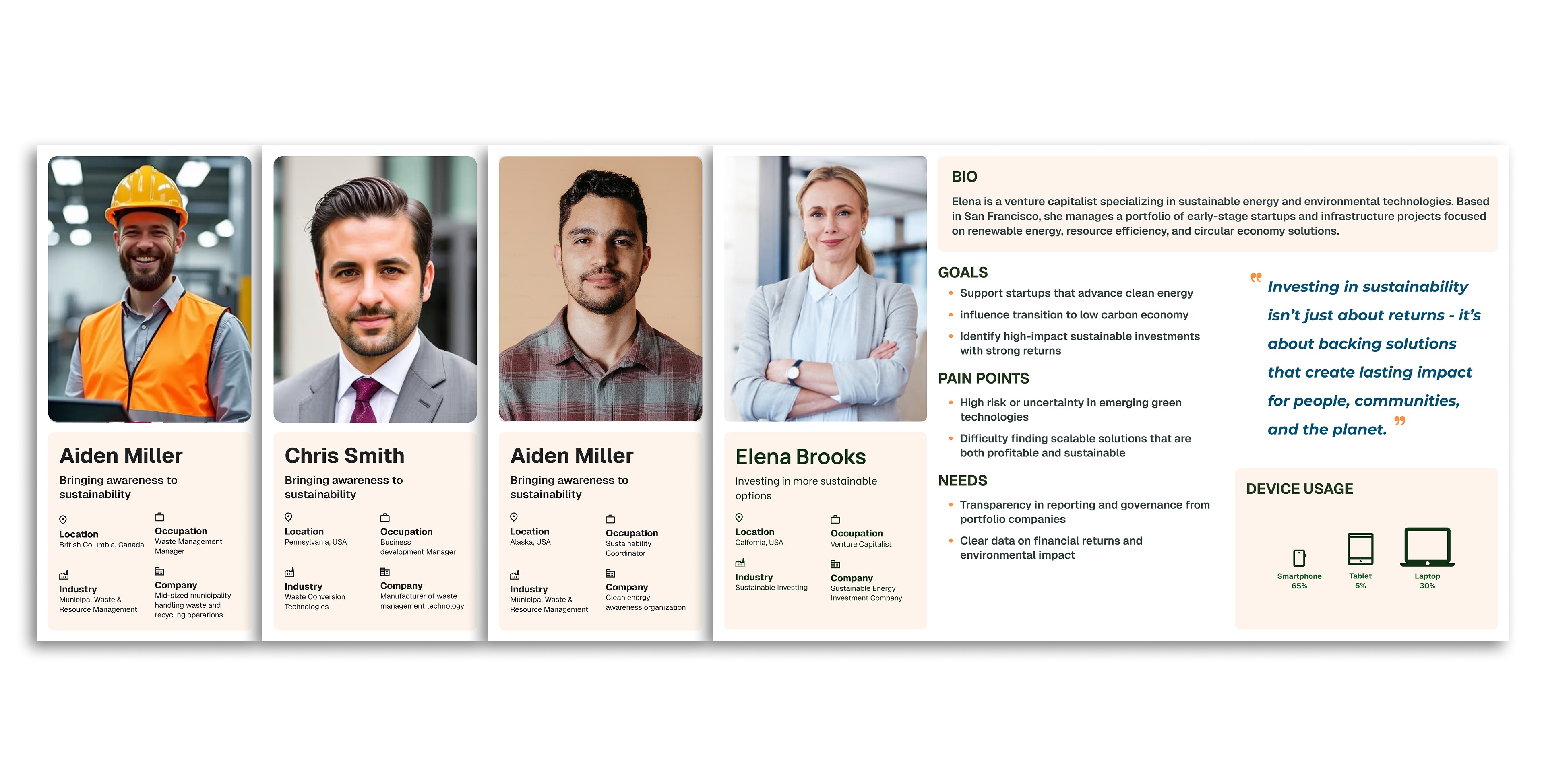
After receiving clarifications, we created 4 personas to guide our team in designing a site structure that meets prospective clients where they are in their journey. Solora's diverse audience had fundamentally different needs and expertise levels. Without clearly defined personas, we risked creating a generic experience that served no one effectively.

How this helped

This helped us visualize the information architecture, identify content gaps, and ensure the structure matched user needs rather than internal departments.
1. Personas

2. Site Map

3. User Journey Map

4. Competitor Benchmarking

4 Personas

After receiving clarifications, we created 4 personas to guide our team in designing a site structure that meets prospective clients where they are in their journey. Solora's diverse audience had fundamentally different needs and expertise levels. Without clearly defined personas, we risked creating a generic experience that served no one effectively.

How this helped

This helped us visualize the information architecture, identify content gaps, and ensure the structure matched user needs rather than internal departments.

1. Personas

2. Site Map

3. User Journey Map

4. Competitor Benchmarking

4 Personas

After receiving clarifications, we created 4 personas to guide our team in designing a site structure that meets prospective clients where they are in their journey. Solora's diverse audience had fundamentally different needs and expertise levels. Without clearly defined personas, we risked creating a generic experience that served no one effectively.

How this helped

This helped us visualize the information architecture, identify content gaps, and ensure the structure matched user needs rather than internal departments.

  1. Entering the Design Phase

With validated research insights and a clear understanding of user needs, we moved into the design phase to translate strategy into tangible solutions. We began with low-fidelity wireframes to establish structure and flow, developed a comprehensive design system to ensure consistency and scalability, then created high-fidelity prototypes that brought the full experience to life for stakeholder review and user testing.

1. Low Fidelity

2. Design System

3. High Fidelity

Low-Fidelity Prototype

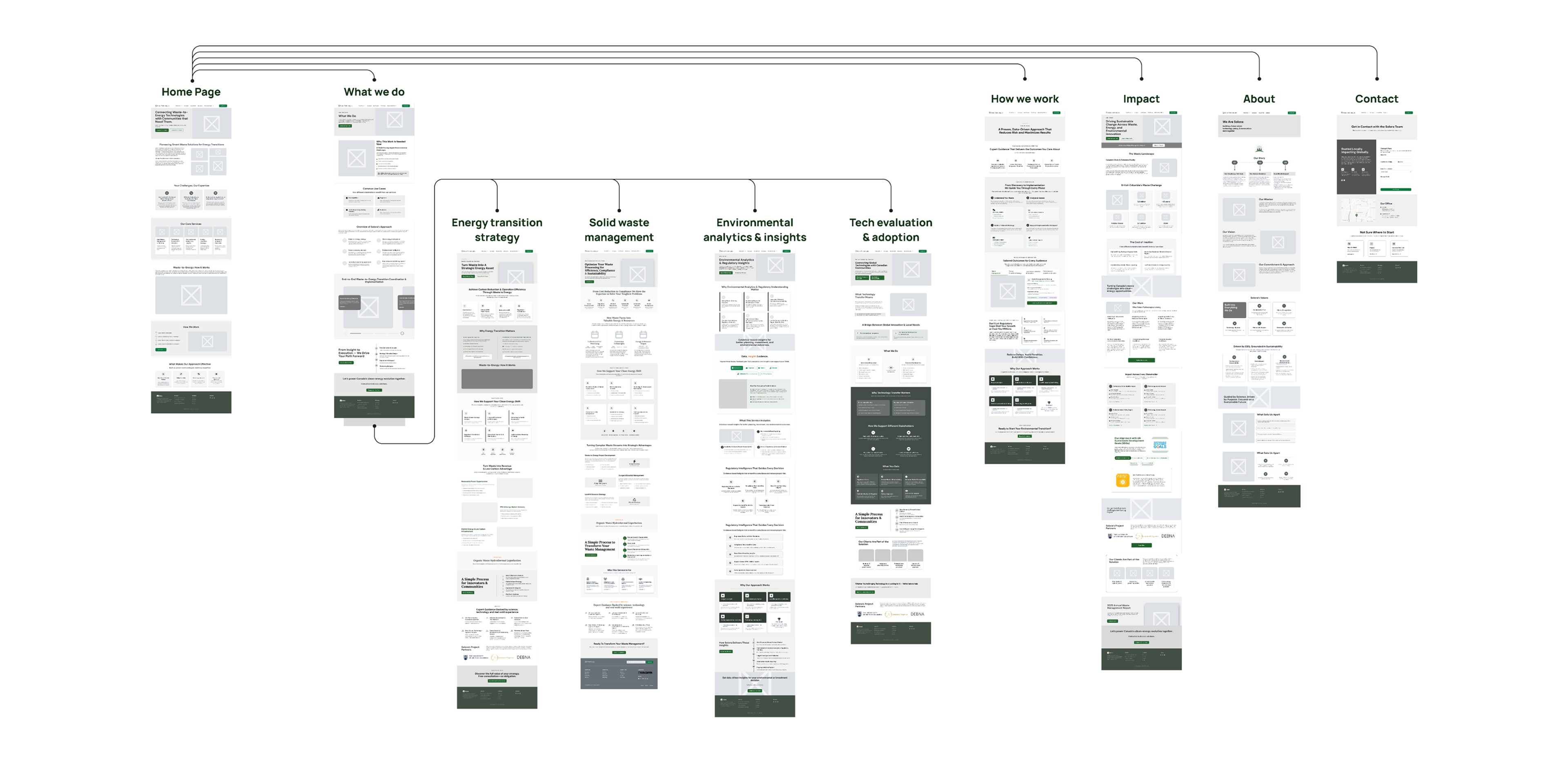
We created wireframes for all key pages and presented the journey each persona would take through the site. We conducted A/B testing with the client and an external user to validate our approach.

How this helped

  • Validated navigation logic and information architecture with stakeholders early

  • Enabled A/B testing of different layout approaches to determine optimal user paths

  • Identified usability issues and iterated quickly without design constraints

  • Established a clear blueprint for high-fidelity design and development
1. Low Fidelity

2. Design System

3. High Fidelity

Low-Fidelity Prototype

We created wireframes for all key pages and presented the journey each persona would take through the site. We conducted A/B testing with the client and an external user to validate our approach.

How this helped

  • Validated navigation logic and information architecture with stakeholders early

  • Enabled A/B testing of different layout approaches to determine optimal user paths

  • Identified usability issues and iterated quickly without design constraints

  • Established a clear blueprint for high-fidelity design and development

1. Low Fidelity

2. Design System

3. High Fidelity

Low-Fidelity Prototype

We created wireframes for all key pages and presented the journey each persona would take through the site. We conducted A/B testing with the client and an external user to validate our approach.

How this helped

  • Validated navigation logic and information architecture with stakeholders early

  • Enabled A/B testing of different layout approaches to determine optimal user paths

  • Identified usability issues and iterated quickly without design constraints

  • Established a clear blueprint for high-fidelity design and development

  1. Validating Design Solutions

  1. Home Page

Bringing together research insights and validated wireframes, we created high-fidelity designs that transformed Solora's website into a clear, navigable, and engaging experience for all personas. We redesigned 14 pages organized into 4 main sections. Each page was crafted to serve specific user needs while maintaining visual consistency through our design system.

Design Solutions

Feature 1

Feature 2

Feature 3

Feature 4

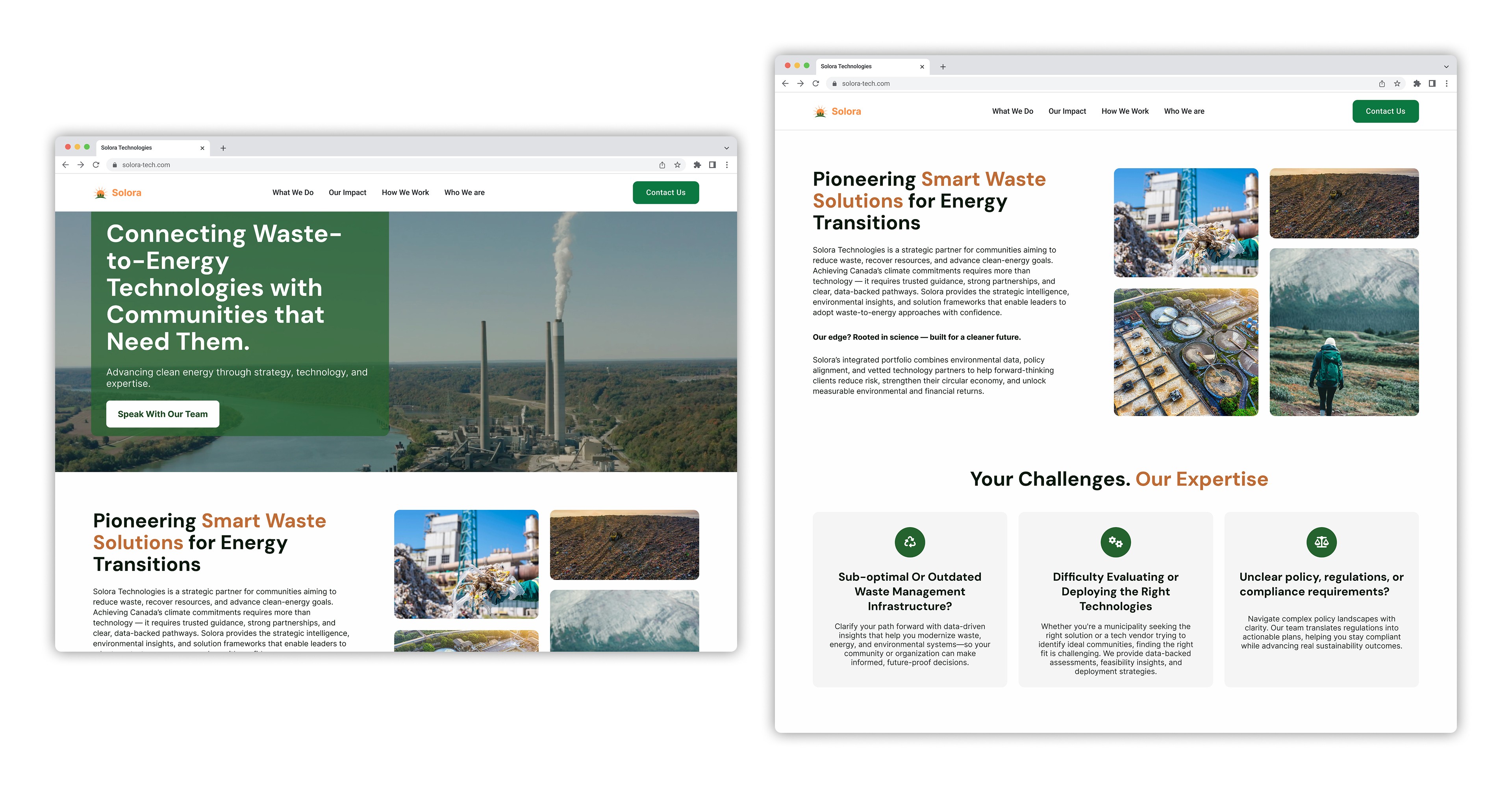
Hero Section

Clear headline and value proposition with environmental imagery establishing immediate brand identity
Feature 1

Feature 2

Feature 3

Feature 4

Hero Section

Clear headline and value proposition with environmental imagery establishing immediate brand identity

Feature 1

Feature 2

Feature 3

Feature 4

Hero Section

Clear headline and value proposition with environmental imagery establishing immediate brand identity

b. The Four Services

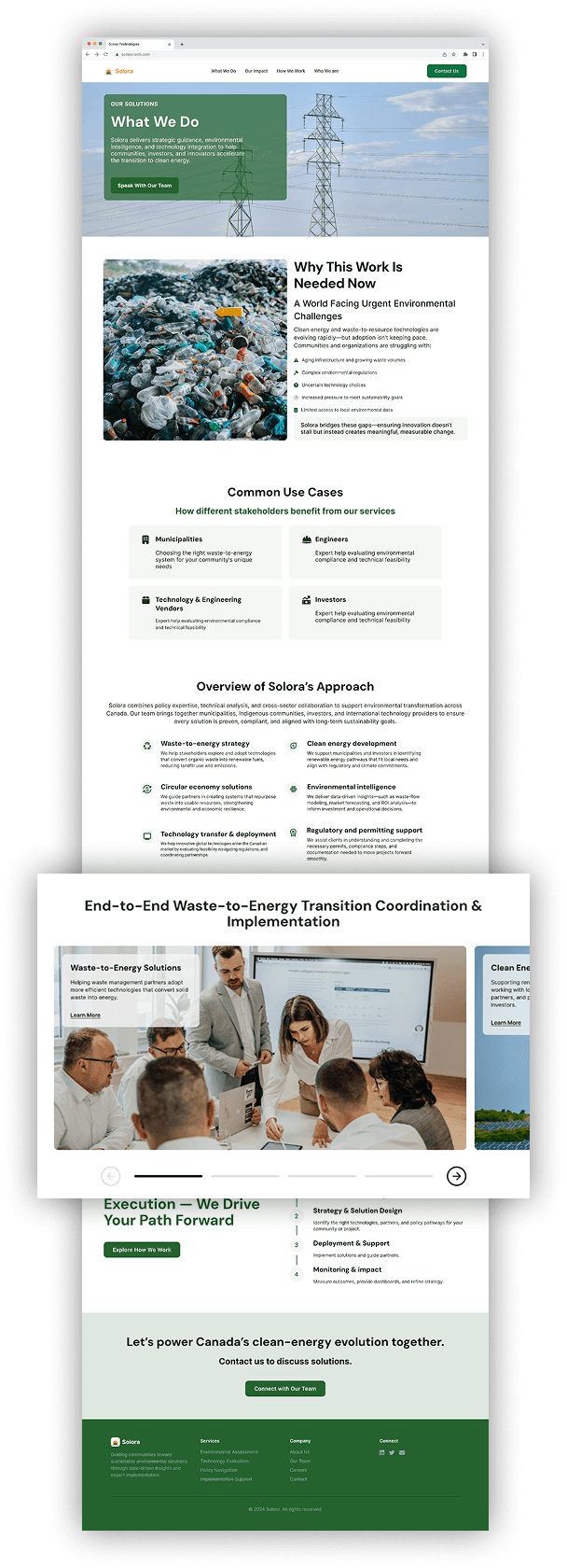
Solora provided extensive information across four distinct services, requiring us to strategically organize dense content into a clear, navigable structure. We implemented a carousel feature for self-directed service exploration, a transparent 4-step process framework, and strategic CTAs at decision points—ensuring users could access detailed information without cognitive overload while maintaining a clear path to conversion.

Design Solutions

UI Solution

Service 1

Service 2

Service 3

Service 4

Service Carousel Solution

We implemented a carousel design for the 4 core services because each service contained dense, detailed information that would overwhelm users if displayed all at once. The carousel allows users to focus on one service at a time while maintaining easy access to explore others, reducing cognitive load. Each service is clickable, letting users dive deeper into offerings relevant to their specific needs or interests.
UI Solution

Service 1

Service 2

Service 3

Service 4

Service Carousel Solution

We implemented a carousel design for the 4 core services because each service contained dense, detailed information that would overwhelm users if displayed all at once. The carousel allows users to focus on one service at a time while maintaining easy access to explore others, reducing cognitive load. Each service is clickable, letting users dive deeper into offerings relevant to their specific needs or interests.

UI Solution

Service 1

Service 2

Service 3

Service 4

Service Carousel Solution

We implemented a carousel design for the 4 core services because each service contained dense, detailed information that would overwhelm users if displayed all at once. The carousel allows users to focus on one service at a time while maintaining easy access to explore others, reducing cognitive load. Each service is clickable, letting users dive deeper into offerings relevant to their specific needs or interests.

c. Building Trust Through Transparency

The How We Work, Our Impact, and About Us pages function as Solora's credibility architecture—reinforcing their vision, validating their expertise, and demonstrating proven results. We designed each page with intentional information hierarchies and strategic CTAs that guide users from learning about Solora's methodology to exploring tangible outcomes to taking action.

Design Solutions

How we Work

Impact

About

Contact

How we work page

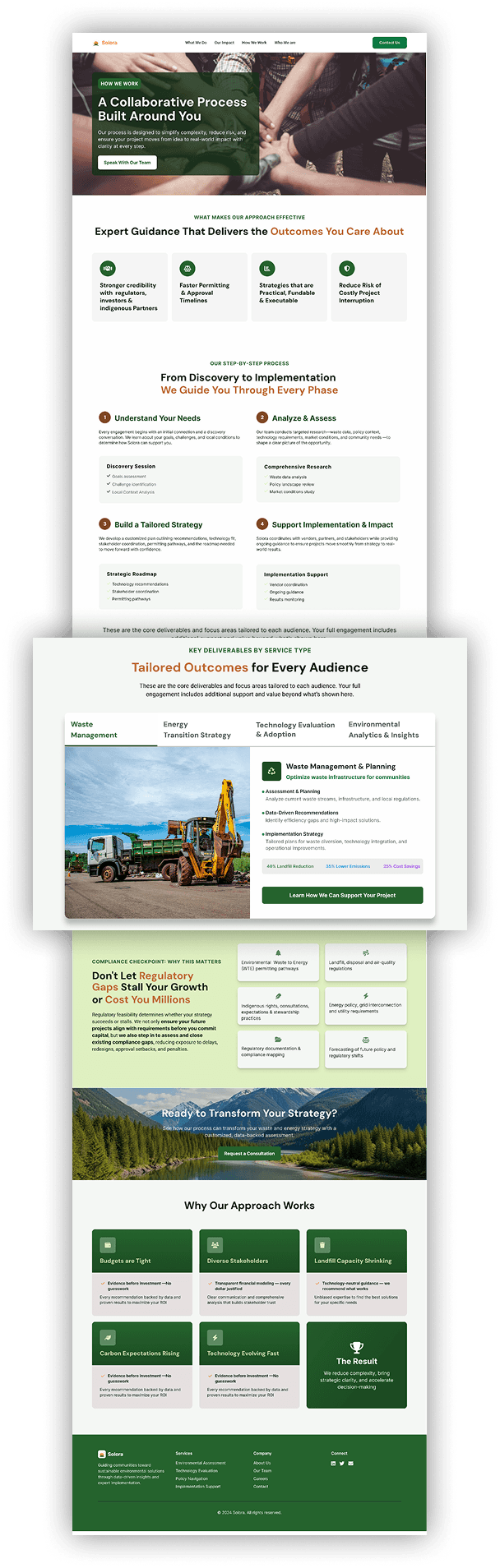
We built this page to guide users from awareness to conversion through a clear information hierarchy and strategic touchpoints.

Key Solutions

  • Trust-building progression: Hero with collaborative messaging → transparent 4-step process → detailed service breakdowns

  • Self-directed exploration: Service tabs allow users to filter content by their specific need (Waste Management, Energy Transition, etc.)

  • Friction reduction: Compliance checkpoint grid addresses common objections before users need to ask

  • Strategic CTAs: Placed at natural decision points—after service exploration ("Learn How We Support") and after pain point validation ("Request a Consultation")
How we Work

Impact

About

Contact

How we work page

We built this page to guide users from awareness to conversion through a clear information hierarchy and strategic touchpoints.

Key Solutions

  • Trust-building progression: Hero with collaborative messaging → transparent 4-step process → detailed service breakdowns

  • Self-directed exploration: Service tabs allow users to filter content by their specific need (Waste Management, Energy Transition, etc.)

  • Friction reduction: Compliance checkpoint grid addresses common objections before users need to ask

  • Strategic CTAs: Placed at natural decision points—after service exploration ("Learn How We Support") and after pain point validation ("Request a Consultation")

How we Work

Impact

About

Contact

How we work page

We built this page to guide users from awareness to conversion through a clear information hierarchy and strategic touchpoints.

Key Solutions

  • Trust-building progression: Hero with collaborative messaging → transparent 4-step process → detailed service breakdowns

  • Self-directed exploration: Service tabs allow users to filter content by their specific need (Waste Management, Energy Transition, etc.)

  • Friction reduction: Compliance checkpoint grid addresses common objections before users need to ask

  • Strategic CTAs: Placed at natural decision points—after service exploration ("Learn How We Support") and after pain point validation ("Request a Consultation")

Key Takeaway

Effective B2B website design requires balancing technical credibility with accessibility. By creating clear information hierarchies, audience-specific pathways, and strategic conversion touchpoints, we transformed a complex multi-stakeholder offering into an intuitive digital experience. The result: users can self-identify their needs, understand Solora's value proposition, and take action—whether that's exploring services, reviewing impact, or initiating contact—without friction or confusion.